

Could be worse
The most wonderful time of the year

December again. I feel a bit bloodless about it; a bit empty. I am not exceptional in this. Indeed, I recall reading that the rates of both suicide and family annihilation increase sharply during the festive season.
I also recall becoming aware, as a teenager, that Christmas was a day of tension for my mother. This was in large part because it involved many hours with her mother, a difficult woman.
Otherwise, the day itself was joyful. One year we had a picnic in a park without Nan. We ate cheese and bread and olives and drank sparkling wine and played Finska. Otherwise, my mother loved the festive season. She adored having family together, all of in our pyjamas double-fisting coffee and Bloody Marys. The chaos and heat in our small kitchen, where several people would stand shoulder-to-shoulder preparing this or that. The noise of even our small family. The end-of-day beach swim.
She was an excellent gift-giver, someone who always had an apropos card at the ready, and who took pleasure in finding items by chance throughout the year and saving them for Christmas. She was a good listener, curious about others, and often salted away small facts or cues to inform her later purchases. There was an intimacy to her gifts. She was purposeful, almost surgical, in her selections. She liked having created modest traditions in the years it had taken her to raise my sisters and I. Mostly, I think it brought her great pleasure to know she had made a family of people that genuinely liked one another, and enjoyed spending time together despite our many differences and idiosyncrasies.
In the last few years, my December has become freighted with anniversaries. The sorts of markers that demand commemoration. For example—
December 14: my mother’s birthday. Also the day on which, in 2022, she left hospital for the final time so we could provide end-of-life care for her at home. The transport paramedics delivered her to the house and helped to move her to the rented hospital bed. After they left, we celebrated her sixty-first birthday.
December 24, 2022: the day my mother died, ten days after that final hospital discharge.
December 19–21, 2023: the days when we learned my father had oesophageal cancer. The timeline is a little imprecise, not through blurry memories, but because the news was oddly drip-fed to us all. The physicians wanted to be sure, I suppose, before they dropped the acid; but in the meantime, he had been referred for a gastroscopy, a CT scan, a PET scan, and I knew where it was all leading. By the time he’d secured an appointment with his medical oncologist and surgeon, before he’d received an official diagnosis, I’d already accepted it.
December 24, 2023: the first anniversary of mum’s death. December 25, 2023: Christmas lunch with our small extended family—my mother’s mother, my mother’s sister, and her partner. Dad did not want to tell them about his diagnosis for fear of exacerbating the day’s anguish.
In fact he did not want to tell my sisters, either. I had to convince him to do so. I felt guilty because it was his news to share. But I also felt guilty possessing devastating knowledge that my sisters did not. They were aware that he’d been having scans and scopes, I told Dad. They knew something was up. Better to tell them the truth now than have them resent being left out of the loop. Even if it were only a few days. Even if he had good intentions.
I had forgotten this until recently, when I was deep-diving through old messages in the name of research. From an exchange with my best friend at the time:
he doesn’t want to tell the girls bc he doesn’t want to compound the anniversary of mum’s death
he was like ‘last year was so sad, i just want them to have a nice xmas’ and i was like ‘well to be honest this one was always gonna suck pretty hard no matter what, that’s nobody’s fault, it’s just gonna be a rough time of year’ and then he started crying
I have learned that one of the most heartbreaking things, for me, is when people are trying to do the right thing but end up hurting one another. Something of the Greek tragedy about that.
My best friend wrote, in the same extended text-message conversation:
It’s like being in a tumble dryer and you get all battered around and sometimes your head just keeps getting slammed against the machine and then occasionally you get a break in between cycles
She wasn’t wrong. But I remember thinking: I wouldn’t mind more of a break. And: I don’t think this is a good way to live. I don’t know if it’s all worth it, just to get a bit of respite in between having your skull slammed against the metal wall of a tumble-dryer. Sorry if that sounds dreadfully pessimistic. It’s just how I felt. It’s how I still feel.
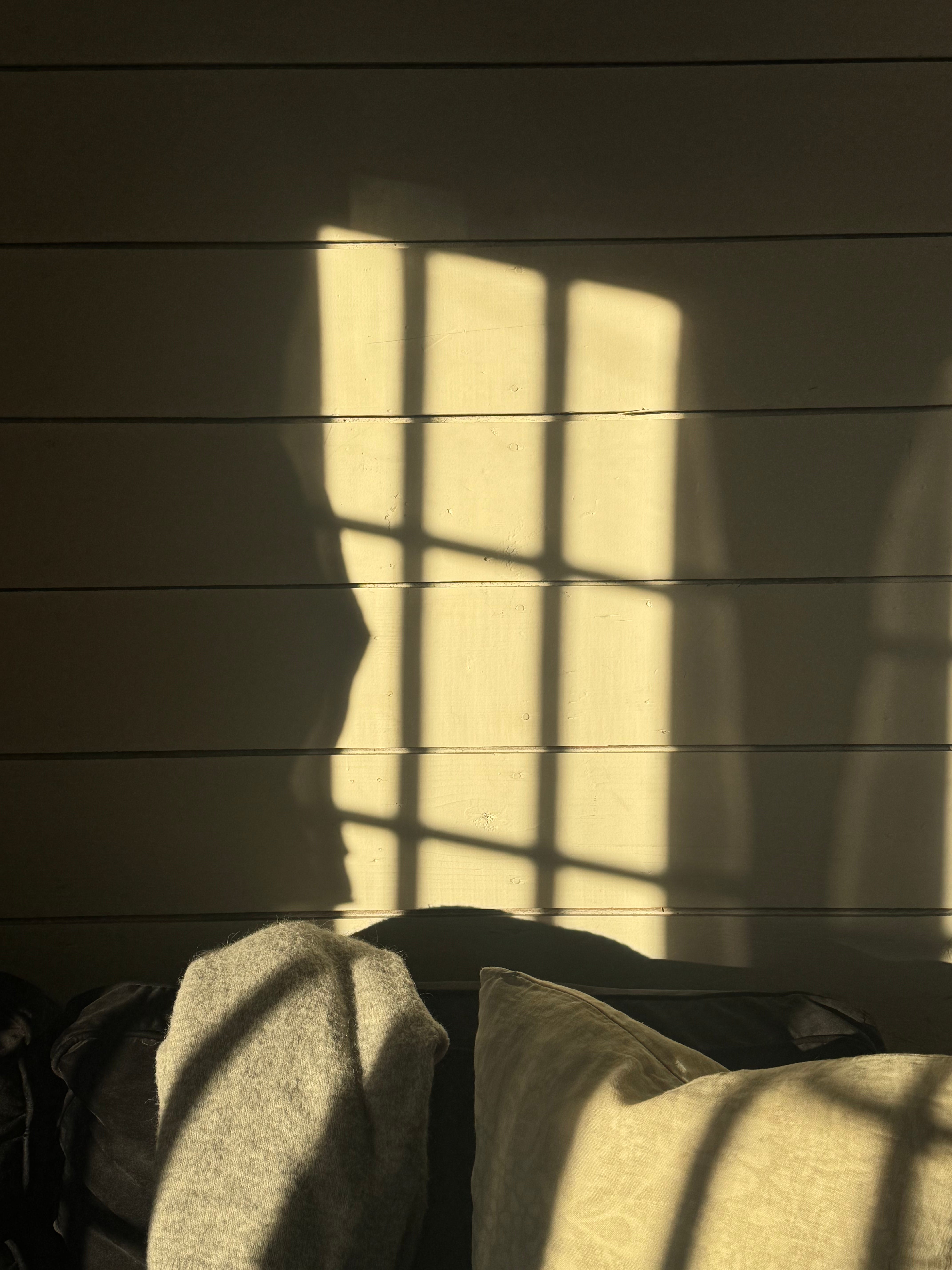
In Connecticut, feeling out-of-practice and dried-up, I tried to do a cheapskate version of Julia Cameron’s ‘morning pages’ routine. I forced myself to spew out three pages each day before I started my real writing. I don’t know if it ‘worked’ or ‘helped’. I don’t know if I will keep on with it.
Sometimes I felt I had very little to say that I hadn’t already expressed, even to myself; or else my own thoughts started to feel deeply masturbatory. So I would collect and regurgitate other people’s quotes. Among them, a paragraph that made me think, obliquely, of people trying and failing to do the right thing:
The tragic hero is complete. You can call him unhappy (miserable, utterly broken) even before he is dead. For an instant he is something like divine. And then he dies, because there’s nothing left to do. The center of every tragedy is the image of a human being who has already died but keeps talking, someone whose face is a mask.
(from Michael Kinnucan’s ‘The Gods Show Up’.)
During one of the 2020 pandemic lockdowns, an old friend of mine died. I had not seen him in some time. We’d become fast friends a decade ago in a novel-writing class at TAFE, and continued, along with a few other mates, to chat and gossip and workshop our novels-in-progress (me Our Magic Hour; him a bleakly funny work of autofiction about his mentally ill mother, his childhood as a queer kid in a smalltown Catholic family, and his demented family dynamics) long after we’d left the Monday-evening classes on Cardigan Street.
More recently, I’d usually seen him at Golden Plains or Meredith, where he and his partner were fixtures. They always camped in the same spot, and usually stayed there for most of the weekend of the festival, and I would pay them a visit of an afternoon to share a couple beers and catch up. He was a sleep scientist with a meticulous mind, and he grew and prepared his own drugs. Once he gave me a mushroom capsule that knocked me on my ass so hard I barely made it back to my friends.
He’d told us he was sick—a rare neurodegenerative condition called multiple system atrophy—but the news of his death, delivered via message from his partner, came as a shock.
Like most everyone else, I attended his funeral via Zoom. There were several camera angles, which gave the impression of watching CCTV footage. The cameras’ movement seemed automated: at one point before the service actually began, the shot zoomed in on a corner of the casket for no reason I could discern, as though it had mistakenly recognised a face or other focal point. At another point, it lingered on one of the brass handles.
My friend’s casket was covered with glitter. He had chosen ‘Willkommen’ from the musical Cabaret as the processional and ‘Ding-Dong! The Witch is Dead’ from The Wizard of Oz as the recessional. It was irreverent and silly and camp, and very him—and yet something about watching the events via closed circuit camera angles made me feel totally, utterly insane, which I mean in the most literal sense: I felt as if I were experiencing some kind of psychosis. (Forgive me if I’ve written about this here before: the day made an impression on me in the worst possible way.)
Later, I told my therapist about this, also via Zoom. It made me feel fucking crazy, I said. Like, it was funny, but it was so surreal and ghoulish to be mourning via Zoom alone in my apartment, drunk at 2pm on a weekday, while Willkommen, bienvenue, welcome played over these tinny speakers.
My therapist pointed out that the purpose of funerals and memorials is to provide a space for commiseration and shared grief; a kind of communion. It made sense, she said, that a virtual funeral would feel completely unnatural and isolating. The glittery casket and musical theatre medley probably hadn’t helped, even if it had all been precisely pre-arranged by my dead friend himself. She suggested I perform a small ritual, however pedestrian, to mark his death. Lighting a candle; something like that.
On my way home from Connecticut, I had a 72-hour stopover in Minnesota to visit some beautiful friends of my parents’ from when they lived there back in the ’80s—the same friends who visited Australia for the first time a few months back. Sometimes when I talk about them I say ‘my family’ because it’s clean and simple and feels true.
L. picked me up from the airport and drove me back to their place. It was cold, minus eight or so, but not unbearable. Her husband D. was waiting at home with tomato soup, grilled cheese and red wine. He had already prepared a quiche for the following morning, he told us. We sat around the table and talked and then moved to the sofa and talked. When I rose and announced that I was heading to bed, D. said love you, honey. Rarely have I known a man to say I love you more than D: he is perhaps more demonstrative even than my father, which surprises and touches me every time.
The last time I was in Minnesota to visit, it was with my family. November 2023—11 months after mum’s death, a month before Dad was diagnosed. I remember, now, our friends commenting on Dad’s weight loss. I privately assumed it was grief, and perhaps not knowing how to cook for himself properly. A week after we arrived home, he went to the GP appointment which, through chance and his physician’s skill, would announce his illness. But before that my father, sisters and I spent Thanksgiving, a holiday we do not celebrate, there in Mankato, a small city two hours south of Minneapolis–Saint Paul. We ate and drank and reminisced and watched football and looked at old photos and laughed until we were nearly sick with it.
This year, I arrived the day after Thanksgiving, the Friday. Over the weekend that followed, I squeezed in visits and catch-ups with as many friends as I (and L., who generously drove me around in a snowstorm that I was not game to brave) could manage. Most people said something along the lines of It’s almost been two years exactly since you guys were last here, huh! They all ask after Dad. Now, honey, what I want to ask is—how’s your dad really going, because we exchange a lot of messages about number forty-seven [Trump] and Netanyahu but he’s kind of light on detail about his own health.
There’s a gap between those statements—it’s been two years since your family was here and how is your Dad. Hammocked in between there is the implicit disbelief that so much could change in twenty-four months.
They remember my father mostly as the thirty-five-year-old Australian teacher who arrived in their small town, gregarious and easygoing and game for anything, with a beard and full head of dark curly hair. They remember him more recently as his 2023 self—no beard, hair a little grey at his temples but still surprisingly dark; older, softer, less muscled, but with the same sense of humour and willingness to go along with anything. But they see photos of him as he is: thin, shrunken to fifty-eight kilograms, hollows beneath his eyes, lush dark hair vastly thinned by chemotherapy. He’s the same inside, for the most part, but his person is unrecognisable. I am shocked by photos from a few years back.
My mother was neither religious nor spiritual, but if she were travelling, she liked to observe customs. In Paris, the first time either of us had been to Europe, I waited while she lit a thin candle in a dark, centuries-old basilica. My mother, who was so anti-Catholicism as an institution that I had to beg her to come to the Vatican museum with me because she didn’t want to give the Church a single euro. Wherever we went, she dropped a coin into the donation box, took one of the cheap pale candles, and lit it.
Years later, we had her memorial service live-streamed for far-flung friends, most of them in the United States. The celebrant, a tall, gentle woman with an Irish lilt, encouraged those watching online to light a candle in mum’s memory.
I thought of my friend Tom, then, and the times I’d lit a small lump of wax in his honour, feeling foolish, not knowing any prayers to say; not believing I could truly commune with him in any real way; but stubbornly committed, nevertheless, to performing my ritual. Just in case.
The years tick like a metronome. Impossible not to think of it like that: this time three years ago. This time two years ago.
On the Saturday of my weekend in Minnesota, I watched D. and R. play a show. They have played together for decades. Their harmonies are impeccable. They don’t have a setlist: they simply consult with each other and pluck something from their vast repertoire. D. plays bass; R. guitar. They both sing, mostly covers. Winding stories.
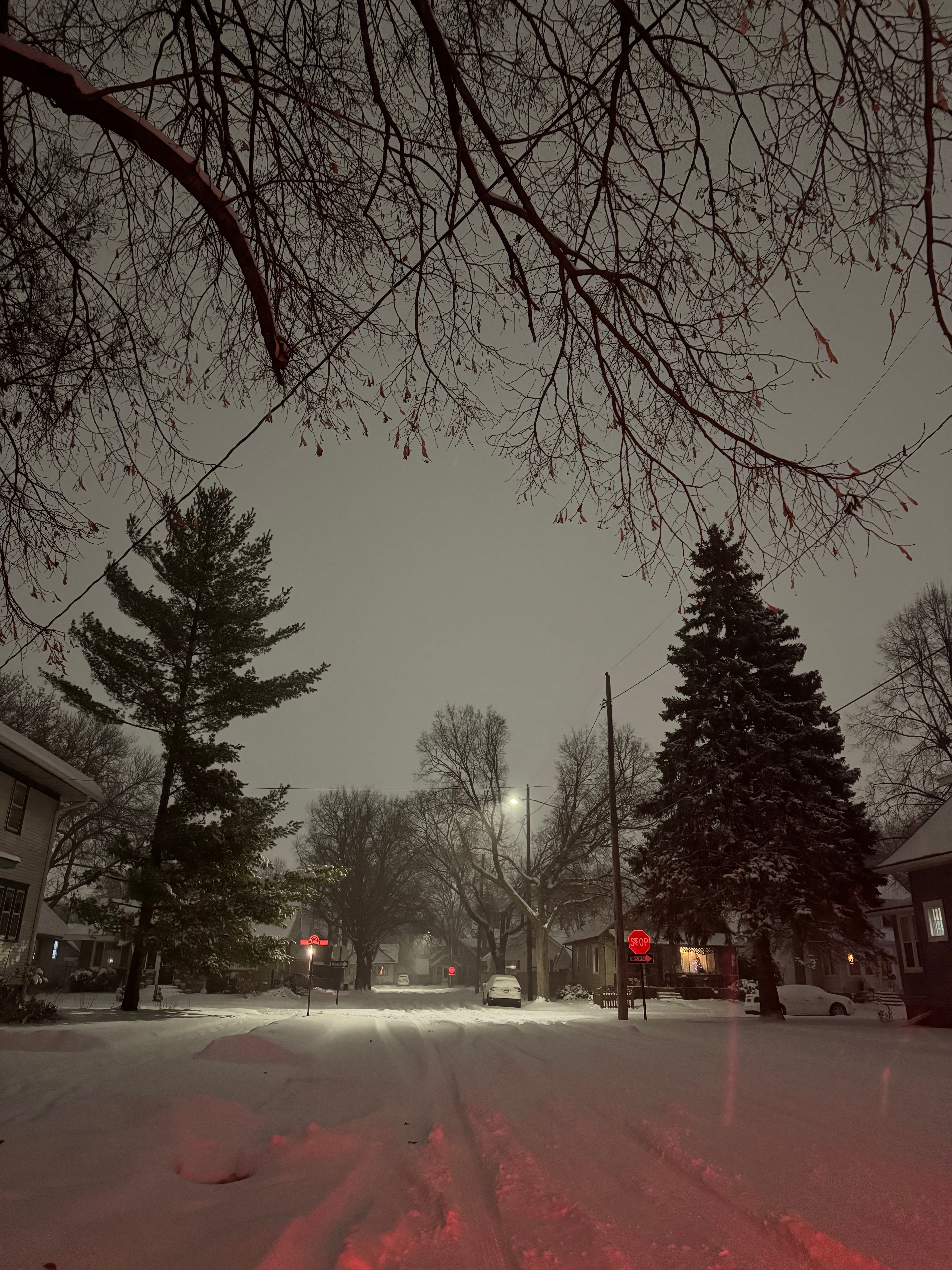
Between songs, tuning his instrument to a new key, R. talked idly about the snowstorm raging outside. Still, though, he says. I never met a Minnesotan who didn’t say, ‘Could be worse’. These folk are of hardy stock, undaunted by snow blindness or ice-greasy roads or temperatures thirty below freezing. People here are accustomed to snot freezing on their faces; to holding a hair-dryer to frozen pipes. The day I left Minnesota to fly to Los Angeles, then Auckland, then Australia, ICE arrived in Minneapolis—the latest target of Trump’s ‘immigration crackdown’. L., a wonderfully civically-engaged woman, had signed up for some kind of protest training. I don’t know if they’ll really let me do anything, because I’m old, she told me, but I can stand there and record [police brutality] with my iPhone.
I am not descended of them, but sometimes I hope to have taken in a little of their calm Midwestern stoicism as if by osmosis. Could be worse, I tell myself a whole damn lot.
I arrive home exhausted and greasy-haired but otherwise fine. I take a car to my father’s house: six weeks ago, I left my car and my dog there. It is a sunny weekday morning. The Australian sky seems wide and clear and blue. My father is sitting on the front porch, waiting, with my dog. She goes ballistic with excitement, throwing herself against my shins. When I embrace Dad, I feel his shoulder blades like wings beneath my palms. He is happy I am home.
Last night my best friend and I had loose plans for a drink. She sent me a message to say she’d drive to mine and we could find someplace nearby. She and her wife had a gift for me that she wanted to deliver. A gift!!!, I wrote back. What for?
She sent another message from the bluestone-cobbled laneway behind my apartment complex to say she’d arrived. When I went to meet her at the rear entrance, she had lugged an enormous potted gardenia from her van and was hauling it towards me. I thought I would burst into tears.
It was actually I.’s idea, she said. Her wife, aside from being a generally thoughtful and intuitive person, also happens to have lost her mother too young. I feel a kinship with her—not just for this reason, but for many others as well; though I do feel she understands this genre of loss more keenly than most of my sweet friends. She, too, was extraordinarily close to her mother.
My friend and I lugged the gardenia up a flight of stairs and positioned it outside the front door to my apartment, where it will get morning sun, but not the scorching afternoon stuff. It has no flowers, for now, but its leaves are a healthy, vibrant green.
They had written me a card wishing a happy birthday to my mother in advance of Sunday, when she would have turned sixty-four, and acknowledging the grief of this month with all its anniversaries. The gardenia was for Mum, but I will be its custodian.
Today, after I wrote to thank them again, I. replied:
Gardenias always remind me of my mum too and I’m so glad that now I think of Liz also. Hope you know how often we think of you and your mum and hold your grief with us too.
It is the recognition that makes me feel less alone. It’s not great, any of it. But it could be worse. I’ll light a candle or two. See if I can make something of it.
I will be lighting you a few candles between now and next Christmas Jennifer XXOO
My mum died of cancer aged 61 last year and this year my dad was diagnosed with cancer, too. I hate that we have these things in common but I find the recognition you write about in your last paragraph in each of your newsletters, and it means a great deal. Thank you for sharing your words.