

Memory and monuments
I'm here, at any rate

Hello. How are you? I’m writing from rural Connecticut, where I’m lucky enough to be one of seven artists in residence at I-Park—the final cohort of this year before the programme closes for the winter. ‘Another residency?’ I hear you say. ‘Does this bitch ever get work done anywhere else?’
Not these days, is my answer! Not much, anyway. For the last few years, circumstances have meant that most of my creating writing and thinking and planning has happened in two-to-four week chunks. More and more, I’ve been struggling to switch gears between professional/freelance work, creative writing-work, and the day-to-day work of life1.
Anyhow, a little introductory note: a few people have asked good questions about residencies, how to apply, why the US, etc.; both via direct message here and on Instagram, so I’m including a short residency Q+A (FAQ?) at the end of this letter. It’s not interesting except for maybe seven of you readers. But let me know if you have other questions or want to know more about any of it. I always assume no one wants to hear how the sausage is made, but I am also not a gatekeeper of info and am always happy to share whatever meagre info I have learned! ! !
Onwards…
In the lead-up to my departure, I felt flat. Worse, even, I suspected I was in a depressive rut. I think I still am, actually. I’m just trying to ignore it for a bit longer.
There are a couple of things that I might identify as factors here, excluding (for brevity) broader sociopolitical events and movements, which, too, make me want to lie down in traffic, but I am better prepared to fight because of a sense of community and solidarity. (Seeing a Palestinian child holding her brother’s remains in a plastic bag, for instance, fills me with a plunging, ageless grief, but I am also fortunate to learn from, and be galvanised by, peers and activists I look up to: people who model action in the face of despair. At this macro level I see impossible cruelty and racism and injustice, and it seems, at times, insurmountable; but I also see resistance, and try to conceive of hope as a discipline. At a micro level, I have love and community in spades, but have not yet found a way to fight despair.) These might be delineated as:
We learned that my father’s cancer has metastasised to his liver. Only a small spot—in fact, the CT scan on its own was not conclusive, but viewed alongside rising tumour markers, the shadow becomes more akin to an object. His oncologist was quick on the uptake; in fact, he’d requested a scan months earlier than normal because of the rising tumour markers, which he monitors diligently. He switched Dad’s chemo regimen. We are now waiting to see if it will have the desired effect of halting or slowing any further growth.
I usually take dad to his oncological reviews, but my nurse sister went with him on that occasion. She sent a message to my psychologist sister and I immediately afterwards to update us on the news. For some reason, I couldn’t stop crying. When I said this to a friend, he said: Not to be a smartass, but I think we know what the reason is, mate. But I have heard similar news—worse news—plenty of times before. Usually I handle it with a façade of relative equanimity.
I walked home from the gym, where I had been when I learned about the liver spot, and I lay on my apartment floor weeping uncontrollably—not in the sense of hysteria, but in the sense of not being able to turn it off. My dog stood over me, perturbed at my tears, wagging her tail slowly. She licked my face a couple of times. At last she sighed and lay on top of me like a 30-kilogram weighted blanket. It did help a bit.A pervasive existential fug that has dogged me for a few months. I can’t quite define it, but it’s something to do with the grief of not really knowing what to want these days, or if it’s worth wanting anything at all. I wrote about it a bit in my last dispatch: Lately I’ve been coming to terms with the grief of having made my life and expectations so small as to be barely-there […] When something bad happens, I can generally accept it, but if something good or stable sours, I feel frustrated with myself for having ever thought it could be any other way. I know I shouldn’t wish for things anymore. (I’ll tell you what I want, having just typed that out, and it’s to never quote myself again <3)
I was—am—shit out of freelance work, and not seeking any because I was headed away for five weeks. Logical, right, but my bank balance is also dwindling. Everything is so expensive. I’m sure I’m the first person to notice this.
Our friends, family, from Minnesota and Washington State visited, and then went home. It was a gift to have them around, and a loss when they departed. Part of it is the not-knowing whether they will see Dad again. Part of it is the anguish of living across the world from loved ones.
I am not a cool chill fun girl, generally speaking, but this is a low ebb. I recognise it: the leaden fatigue. A nagging dread, like the kind of period pain that drags down into your legs, which says: Is this all there is, forever and ever? I don’t think this is a good life. Perhaps I’m wrong and greedy but I don’t know if this is enough for me.
Speaking with a friend, I made an offhand comment that time-wise, I’m probably halfway through my life. She did the math and said, You’ll live longer than seventy. I suppose I might. With my family history, though, it does not feel as though the odds are in my favour. I’m only being honest.
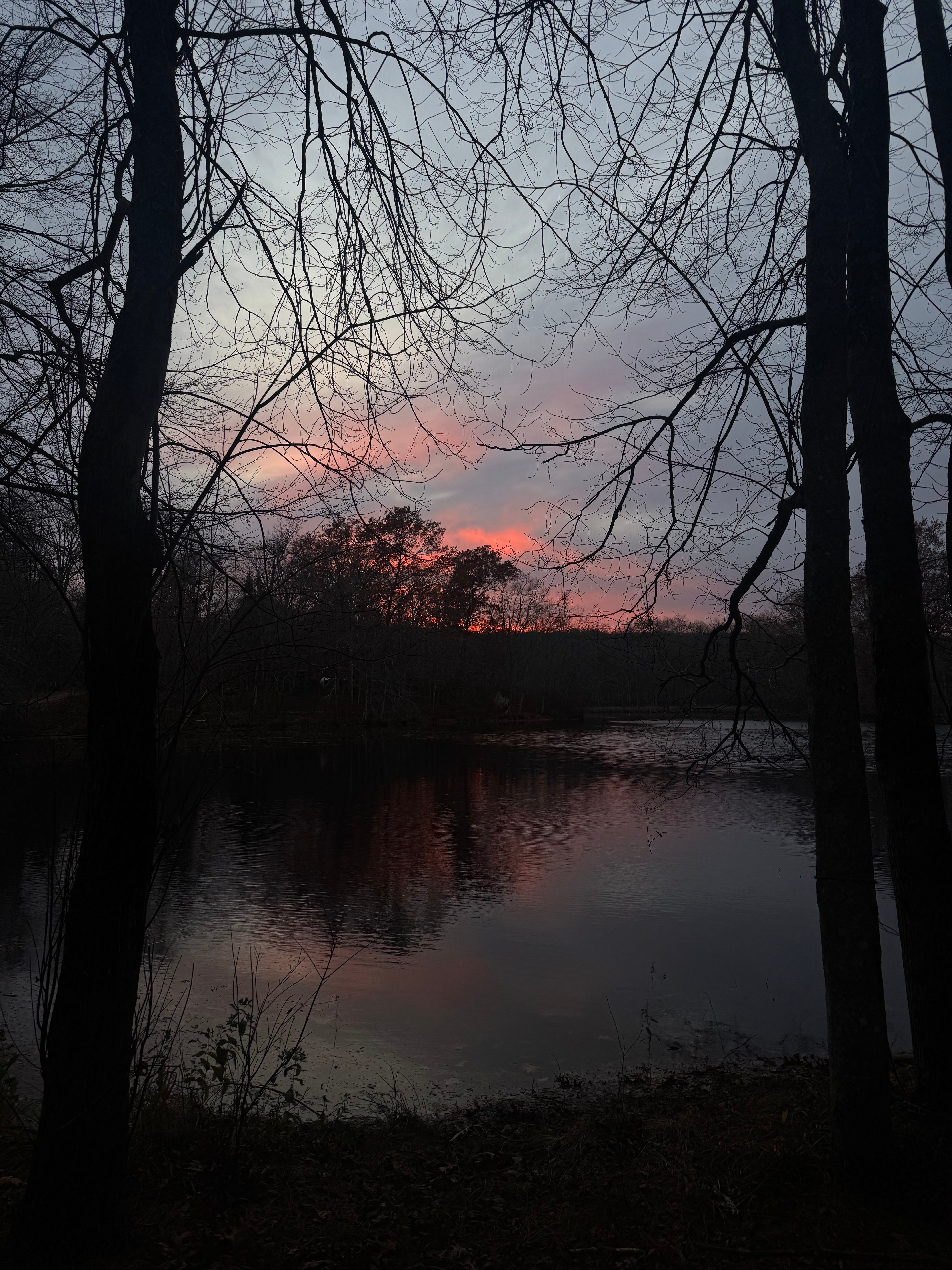
I’m here, at any rate. The residency is situated on 450 acres of land, including numerous walking trails, a gravel pit, a pond and small dam, a pine grove, bamboo tunnel, and stretches of land either side of the Eightmile River. There is a tremendous amount of pumice, and also mica: on a sunny morning, the paths glitter with it. There are dramatic boulders and birch trees and white oak. Sections of the land are covered in bright-green moss, spongey underfoot. Elsewhere, the fallen leaves make an inch-thick carpet. It smells nutty and loamy. This is one of my favourite scents in the whole world.
This is a multidisciplinary residency, but has a particular fondness for land artists and other practitioners engaged in site-specific practice. For this reason, the property is also dotted with various outdoor sculptures, structures and installations—some small and tucked away, others whose larger scale called for concrete slabs, solar power for lighting, and so on. Most of these artworks were originally intended to be ephemeral, and so, over time, some have begun to decay or break down. Others, including a 2013 work by British sculptor Tim Norris, remain remarkably intact.
We are headed towards late autumn, and many of the trees are bare, but some determined foliage remains.
On my second night here, over dinner with my fellow artists, I learned that the land itself was originally purchased with a vague plan for artworks with a focus on memorialisation. There is a whole other section of the property, I discover, known as the Netherlands, which is entirely devoted to site-specific artworks focused on memorialisation, grief and memory.
This answers a few of my idle questions. (For instance, among all of the marked trails and tracks, I have noticed one called Thanatopolis Trail. My layperson’s etymology brain went Thanotos, personification of death; topos, place; polis, city, but I forgot to look up the word or the origin of the trail itself.) It transpired that one of the artworks in the Netherlands section of I-Park was created by the friend of one of the current artists-in-residence in tribute to another mutual friend of theirs.
R., one of the residency founders, is telling us this. He is a healthy-looking man in perhaps his late fifties, with a close-cropped white beard and hair, I guess, beneath his beanie. He has a New England accent that sounds murky to me: he says he went to school in Boston, but I don’t hear aggressive Massachusetts, just something indefinably north-east. I’m no expert, though. He’s friendly, but taciturn; almost shy. When a colleague asks if he’s an artist, too, he just says No and looks determinedly at his ice-cream. He does offer, though, to show us around the Netherlands, and he seems genuine. None of us really understand what it is yet, but we all say we’d like a tour.
So yesterday morning, Saturday, R. takes us around the Netherlands. It’s a crisp, mild morning, sunny and still. He has printed off a map for each of us, marking various artworks, sites and paths, along with centuries-old stone walls and general topography.
R. has a habit of beginning a terribly compelling sentence, then letting it peter out to nothing. Something shy and uncertain in the way he speaks, though he strikes me as a deep, slow thinker; someone tremendously in touch with the natural world, who loves art and artists, and who feels things at an almost-cellular level. Once I get beyond the frustration of an aborted story, it’s endearing.
Recently we’ve had a problem with rust, he says about one large-scale artwork. There’s been some leakage. [The artist] liked the rust, that was—and then maybe I stuck my nose in it, maybe I had a little different—anyway. I don’t like to have a dead end, but this is kind of a dead end, here. (It takes me a second to realise he’s speaking literally, about the pathway.)
We’re kind of anti-cemetery, by the way, he says at one point. I think I’m part of that baby boomer generation where we’re thinking hey, maybe there’s a better way of doing this. Maybe there’s a space for a different kind of memorialisation—he shrugs—and maybe this can be a place of experimentation, to kind of figure it out. Anyway. Those pink ribbons are wetlands delineations.
This piece is inspired by the paupers’ graves in places like New York City or whatever—like the tomb of the unknown soldier. So the artist wanted to use stuff from the junk trail and also some stuff from his own organisation in Lyme, Connecticut. So this is very modest way of commemorating someone’s loss.


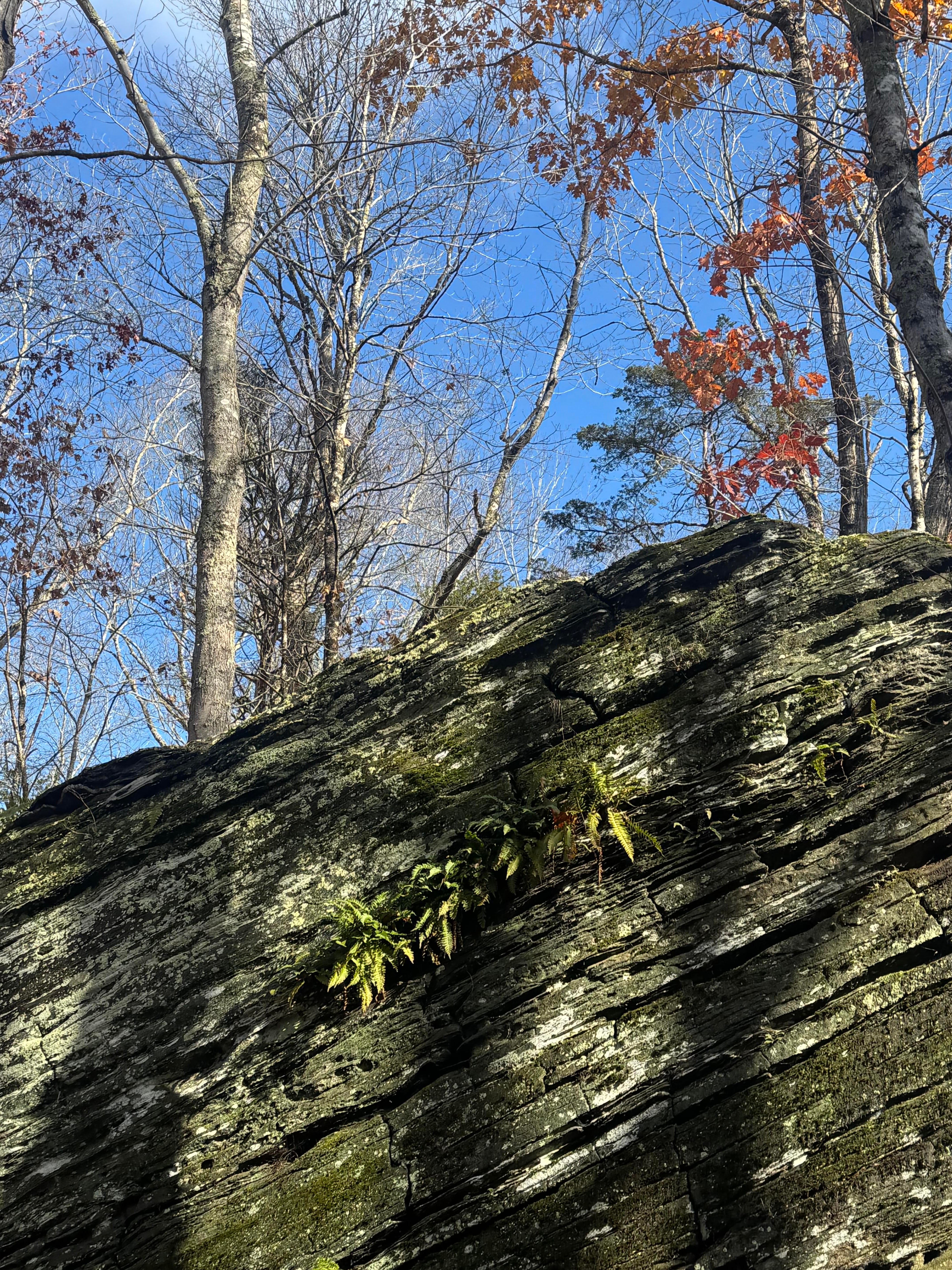
Running in the woods, I pause, breathless, to examine an enormous rock. There is a fissure no wider than a fingernail through which a sapling is grows. Green shoots even at this late hour of November.
Showing us around the Netherlands, R. points out a large, elegant boulder, roughly triangle-shaped and three times my height. We call it the monument, he says. I feel pretty certain that it would have been of significance to Indigenous people here, though I don’t know that for sure. It’s kind of interesting; it’s changing over time. Half of it has the quality of petrified wood, so it’s sort of brittle. We could probably learn more about it, for sure. We just haven’t asked a geologist to do the work of telling us what’s going on. But maybe it’s better to keep it a mystery. He turns abruptly and begins walking away, uphill, towards the next site of note. A few of us linger to examine the stone; its clean, ancient planes; its lichen. A thatch of fern fronds bursts impossibly from the boulder’s surface.
I think about this new growth. Nature persists in the most impossible places.
Not in my life, certainly, but I do see it. I do want to be it.
Walking among the pines, I remember something my mother said to me a few weeks out from her death. She had been appointed an oncological psychiatrist. He was a skilled practitioner; a man a little older than her, warm and understated. Unlike the god-bothering, busybody pastoral care worker in the Catholic hospital in which she was treated, he did not discuss religion or spirituality with her. She liked and trusted him. I never met him, but I have an image in my head.
The last time she saw him, she told me, she was apparently discharged from his care. She said to me: He wished me a peaceful journey.
Thanks for being here. Take care.
A note on artist residencies and my stupid fortune
This year, a few people have privately replied to my letters, or otherwise sent messages, asking about residencies. I will say first and foremost that I have been exceedingly lucky this year; perhaps more so than any other I can recall. I don’t know why this is: perhaps because in a few applications I’ve mentioned caregiving-work and maybe some jurors/assesors feel sorry for me? Certainly, I have submitted stronger writing in the past than what I sent out this year. Maybe I sounded particularly desperate. Maybe they were down on applicants. I don’t know the criteria by which each org selects its fellowship/grant/prize/etc. recipients, but I do know, having judged a handful of lit prizes, that a lot of it does come down to timing, luck, and compromise (or sometimes total likemindedness!) with fellow judges.
How do you find residencies to apply to? Once a year—usually in January, in that slow, slack period of freelance work—I trawl places like ResArtis and make myself a list of residency programmes and grants along with their application deadlines, associated costs and other considerations, residency dates, when applicants can expect to be notified of the outcome, etc. Then I put the deadlines in my calendar and apply for as many as I can. Mostly I’ve followed the same institutions and orgs for years now, and subscribe to their comms so when they put a call out for applications, I get an email.
I only look at those that are financially viable for me: fully funded, or which offer a stipend. There are, of course, paid programmes if you have the means.Why North America? That’s where I’ve had most success, applications-wise! There are certainly plenty of cool residencies in Europe, though many of these involve paying an amount beyond my means once airfares and other expenses are factored in. I’ve run across several in Japan, China and India, and a couple in West Africa—but from what I’ve seen they tend to be geared towards visual artists and performers.
North America seems to have a culture of (mostly) not-for-profit orgs that partly, if not fully, financially support artists’ stays, often going so far as to feed and house them at little or no cost: MacDowell, Yaddo, Millay, Vermont Studio Center, Jentel, Djerassi, Banff Centre for Arts and Creativity, UCross, Hedgebrook.What about travel costs? Some residencies offer a travel stipend or grant, usually means-tested. For this current programme at I-Park, I applied for, and received, one of eight grants from the Neilma Sidney Literary Travel Fund via Writers Victoria. These grants are generously awarded a few times each year, and are not just open to writers, but editors and other literary industry professionals, too.
To elaborate: I think I’m too fried, these days, to really lock in to creative work between a 7am chemo run and 12pm house clean for dad, a 4pm freelance call about ‘brand’ ‘identity’ for [redacted client], and a 7pm classical Pilates class for my sanity. At home I’m just trying to keep my head above water. There’s not really any room for play or joy or dreaming or the kind of research that feeds a novel. Something always has to lose, and in a three-way choice between caregiving, paying my rent and ~doing what I love~, the latter is always going to lose out. I mention this not to be a sad sack whinger but because a couple of people have also asked recently, via various platforms, how I manage to balance X and Y and Z, and my answer is: I don’t. I really do apologise if social media etc. gives that impression. I try to keep it real, and the reality is that something is always losing out, and it’s almost always book-work UNLESS I’m at a residency.
Thank you for sharing all of this. You're managing such a lot at the moment and it's no wonder it feels dark and difficult. Hope the residency is exactly what you need it to be x
yes to all these! & especially resonating with the footnote. i feel you. i think of you often. thanks for sharing as always x