

Playing house
The cage is open
Seven a.m., I leave my childhood house, the dogs trotting eagerly beside me. It’s a pretty morning. Heavy dew, sky streaked with pink. I point the remote at the gate1. It slides open an inch or two, then catches and closes once more. I press the button over and again. I examine the metal runner for possible obstructions, finding none. This marks the end of my investigation: I am not particularly mechanically minded. I look at the dogs. They look at me; Martha with an expression of dumb, cheerful expectation, Bessie with puzzlement and waning patience. I suspect she is about thirty seconds from letting loose a single cannoning bark of frustration. I feel the same.
I send my father and sisters a message with a video of the gate opening, stalling, closing again. I’m trapped in the fortress, I write. I attempt to exit through the pedestrian gate only to find it jammed shut by rain and disuse.
Panic rises in my chest. Sure, I can climb the six-foot fence, but I can’t bring two thirty-kilogram labradors with me.
The panic is more to do with my day’s plans being disrupted than any actual sense of being booby-trapped. I have two university assignments due and a job of freelance work. I need to clean, and visit my father in the hospital, and get groceries, and so on. My seven a.m. dog walk was the first task on my list. I wanted to tire them out before the day became too warm. I also wanted to buy a coffee, though I could just as well make one at home. My car is in the driveway. I can’t go to Dandenong to visit Dad. I can’t go anywhere.
I fetch a screwdriver to see if I can remove the hinges from the pedestrian gate, or perhaps jimmy it open, but the screws are tightly fastened. I need the drill. I find my father’s set of house keys to see whether his remote will yield a different outcome. No dice. I am close to tears, and embarrassed about that.
The dogs wait with surprising patience, given their twin enthusiasm for any excursion. I go on desperately pushing the button until the gate suddenly slides all the way open, as though nothing was ever wrong in the first place. I examine the runner, astonished. I snatch up the dogs’ leads and run out onto the footpath. Martha instantly squats to piss on the nature strip, looking up at me as if for reassurance: Are we really free?
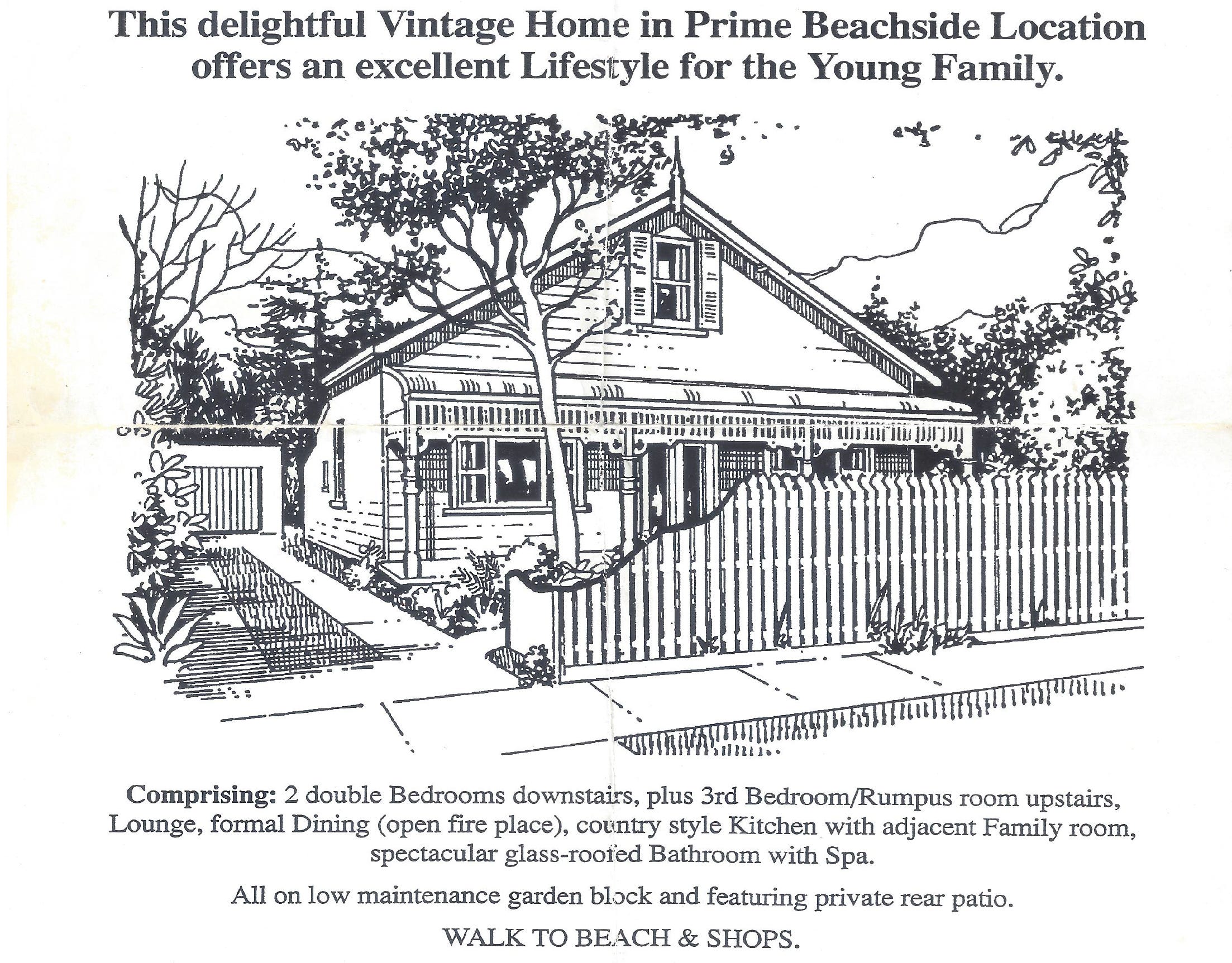
The house sits on a narrow, awkwardly triangle-shaped lot. On one side is the driveway; on the other, a grassy pathway that dead-ends in a sharp point due to the angle of the property line.
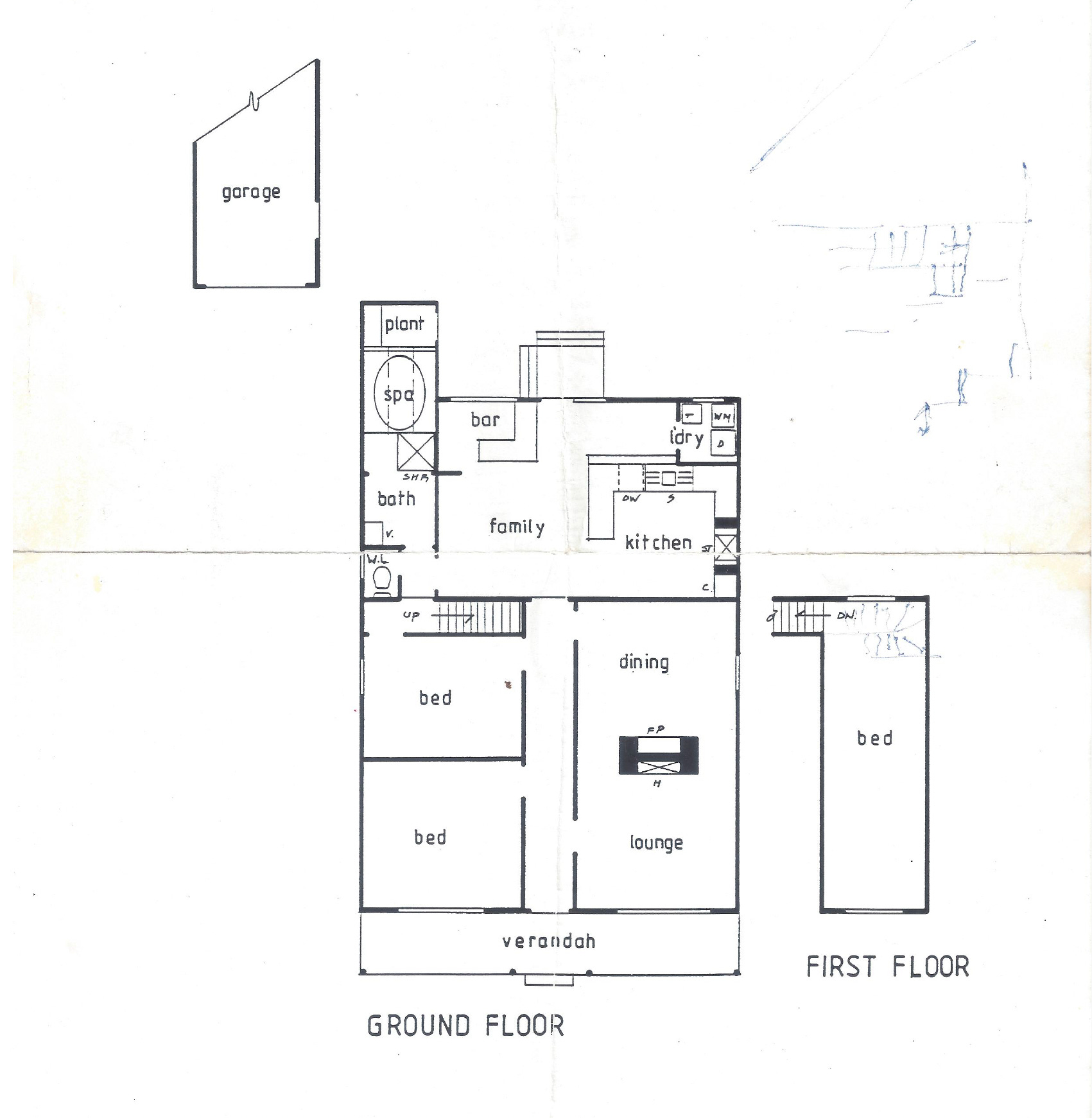
Growing up, over the years, I had three different bedrooms. This suggests a large dwelling, which is not true: to this day, the house has a single bathroom and a modest kitchen. It has the advantage of being old, by so-called Australian standards, and, by consequence, its rooms are relatively spacious and high-ceilinged. Over the years my parents had a wall constructed to divide one of the larger rooms.
When I was a child the laundry was a small, rotting room falling off the side of the structure like an afterthought. In fact, a lot of the house was rotting or rusting. Loose bricks, peeling linoleum, crumbling floorboards. Bizarrely, in place of a regular tub, there was a spa bath. It had brass fixtures and seemed to me, as a child, very luxurious, perhaps because for a long time we were not permitted to use it due to water restrictions. Before the drought, though, my middle sister and I bathed together. I have long memories of the two us in the tub, our hair pulled into wispy knots on top of our skulls, inventing games from the basket of bath toys my mother kept beside the tub. I remember chickenpox Pinetarsol baths and fever-cooling baths and tantrum-extinguishing baths.
When I was twelve or thirteen, my parents renovated and repurposed the attic, which would become my teenage-through-young-adult bedroom. It was long and narrow. Its walls and ceilings were tongue-and-groove boards. It was the only upstairs room, and poorly insulated: freezing in winter, baking hot in summer. It felt grown-up to me, a kind of retreat.
At night, with my bedroom window open, I could hear cars rushing too fast down the highway at the end of our street. The clatter of the railway began early, long before dawn. My room had French windows at either end. If I opened the street-facing ones at dusk at a particular angle, in the right lighting conditions, I could see the trains reflected in the glass as they hurtled along the tracks. They seemed suspended high in the air through a trick of visual logic. Light glinted from the plexiglas squares of their windows.
The windows at the rear of the house opened onto a view of other people’s houses and a few tall palms. It used to be that you could see a sliver of the ocean from there, though not to my memory: townhouses have eclipsed the view since I was very young. You could climb out of the windows, though, and sit on the corrugated iron roof, which sloped at a gentle angle towards the backyard. This, too, felt thrillingly teenaged and suburban. I think I romanticised it before I understood what that meant.
When I moved out of home, the room became my youngest sister’s. When our mother was dying, and I had moved back to help care for her, I used take my telehealth therapy sessions from there because it was offered the greatest privacy and quiet. My sister, who still occupied the bedroom at that time, would light a scented candle and leave me a glass of water or cup of coffee.
Recently, sorting through some old boxes in the attic storage space, she found a box of our mother’s keepsakes—greeting cards, notes from friends, my sisters’ childhood drawings, a stack of letters sent by my dad from the period after he’d moved to Minnesota, but before she’d left Melbourne to join him.
Among the paper ephemera, my sister found the original leaflet for the house, produced by the estate agent in 1989. Instead of a glossy twilit photograph of the property, there is a sketch. I wonder if this was common at the time, or if perhaps it was done to flatter the peeling weatherboard edifice.
On the reverse of the leaflet there is a neat floorplan. In one corner, a faint biro diagram of the staircase, drawn with light, brisk strokes. I assume this was done by my mother’s father, who we called Pa, because he was a skilled carpenter, and also because the drawing bears evidence of his non-Parkinsonian tremor.
In the same plastic crate my sister also found the handwritten building condition report. The property’s flaws are numbered well into their thirties. Floors not level. Stair is obviously steep + is considered unsafe […] Does not comply with building regulations. Dirty old flue above stove. Electrical wiring [….] unsafe - replace as soon as possible.
For the last month, I have been alone in this house, looking after it and my father’s dog.
In many ways it is completely familiar. I grew up here. I moved in while my mother was dying, and more recently during and after several of my father’s hospitalisations. I know the sounds and strangeness of the house: the way the wind moves through it; the way its doorframes swell with humidity; the way, in blustery conditions, the upper branches of the lemon tree scrape aggressively, so loud it could be a person walking across the roof.
Since my mother’s death, however—or perhaps since my father was diagnosed, since the first time I spent several weeks alone in the house—it’s different. Too much time here makes me dreadfully unhappy.
Being here alone is strange. Being here with my father, newly frail and fatigued, is weird, too. The structure is the same, though sometimes I have the sense of us disintegrating within it. The house will outlive us all.
But that’s narrativisation. Point of fact, when my father dies and my sisters and I sell the house, its new owners will more than likely demolish it to make room for something newer. That’s how it goes, mostly.
Last week, right in time for the low staffing ebb of the Easter holiday weekend, my father was discharged from hospital after a six-week admission.
We have purchased a chair for the shower. We have rented a walker, which has remained untouched as Dad has only shuffled from room to room, and with increasing confidence.
My friend F., a palliative care social worker, sends me a screenshot from her phone’s Notes app. It is a stat she once recorded at a conference: 10 days in hospital equates to 7 years of ageing in muscle wastage.
My father now weighs fifty-two kilograms. The elasticised cuffs of his tracksuit pants hang slack around his ankles. When he lies on his belly so that I can change the dressing on his almost-healed pressure sore, I see his skeleton beneath his skin: his ribcage, the neat row of spinal vertebrae, the bony wings of his shoulder blades. With time, it is hoped, he will continue to rebuild strength, muscle mass and body weight.
I tell my therapist about the gate—about being trapped—during our telehealth session, which I take in my teenage attic bedroom. I say: If a student put that in a story, I’d go, ‘Look, that’s a bit on the nose’. I am trying for a moment of levity in between hacking sobs. Lately I have cried every day, often multiple times, often so hard I throw up, so that I have to eat an Ativan in order to do anything except cry. I think I am probably depressed but what am I going to do about it. I’m already medicated to the hilt. My depression is at least partly ‘situational’ but the situation is endless. Maybe this is as good as it gets for me.
My therapist tells me I need to get out of the house, and not just to walk the dogs or run errands. You need to go back to your apartment, even if it’s just for a few days. I know that you and your sisters can negotiate that. I tell her I will, knowing I won’t.
It is logistical: my work schedule is, by far, the most flexible of mine and my sisters’. I am not required to show up in person or attend rigidly timetabled shifts. It is therefore no trouble for me to move my belongings, dog and self to my father’s house for as long as it takes.
It is strategic, too: I am patient with my father (though never as patient as I would like to be). After we all spent Easter weekend together, my youngest sister sent me a message: [her partner] and I were just talking abt how grateful we are for u … [caring for Dad] 1:1 would be A Lot […] u are very very patient’. It is true that I know how to manage him, though this is arguably self-serving, since I am intolerant of his fleeting but childlike temper.
Staying here is also (selfishly) self-protective. Here, I am geographically isolated from my friends and neighbours. This offers me a convenient excuse for absence, instead of the true explanation, which is that for some time now I have not been able to relate to their lives in any meaningful way, and that, to my shame, their normal adult joys make me feel deranged.
It’s not even jealousy, although I would understand if it were read that way. Rather, it is a sense of total and unbreachable isolation on my part. It is a Wish you were here! postcard from a tropical locale while I sit in a dystopian, chemically-lit office cubicle. It is a fault of my neurochemistry, perhaps, that I so quickly forget how to commune with friends around a dinner table or in a noisy pub; but the fact remains that I don’t remember how to do it.
I tell my therapist: What am I supposed to do if I go home for a couple of days? I don’t even want to see any of my friends. It doesn’t matter whether I’m here or there.
She says: I don’t care what you do. It doesn’t matter. You don’t have to see anyone if that’s going to heighten this feeling. You can do nothing.
The point, she seems to be saying, is getting out of here.
I feel bad for the house. It’s not really to blame.
The logic of staying here has begun to seem metaphysical. Since the gate jammed, I have not been game to shut it again, but it wouldn’t matter if I did: I feel stuck anyway. I had a dream that I tried to leave the suburb but got blown up by a mine. Like I said, it’s all very lacking in literary abstraction.
I keep thinking of that lonely and lovesick Ask Polly advice-seeker from a years-gone column in The Awl, who signed her letter:
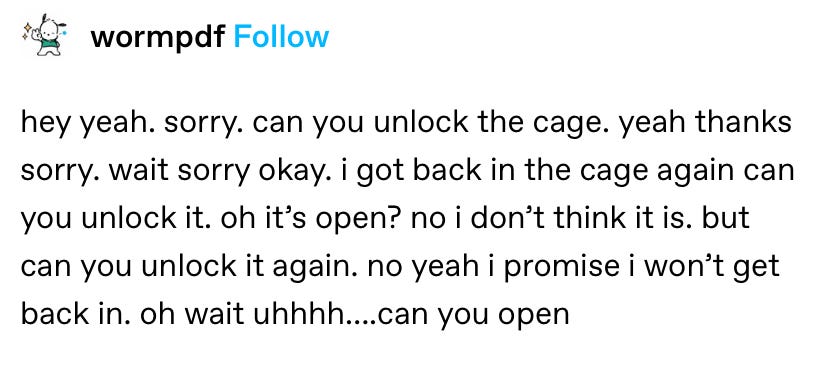
Please help me get out of that cage!
Can’t Stop Eating Rotten Cabbage Leaves
—and of the first lines of the agony aunt’s reply:
The cage is open. You can walk out anytime you want. Why are you still in there?
—which always brings me to this text post:
Each time I am alone in the house with my father for more than a few days at a time, I am—stupidly—surprised and a little bruised when we lapse into the same established pattern, particularly when he is unwell or recovering from an acute illness.
He, understandably, is exhausted and preoccupied with his bodily wellbeing He reports to me the quality and duration of his sleep; his bowel movements; his energy levels; his hypotheses about pharmacological side-effects and interactions. I play the part of a dutiful nursemaid: I remind him to eat, prepare his meals, fix cups of tea and coffee. I cook and clean and take care of other household work.
After some time—usually a week or so—I begin to feel resentful; not of the caregiving load, but of the sense of being an employee rather than a daughter. I will begin to tell sisters and friends that I just wish he would ask me one question! or complain that I know he’s not feeling well, but every single thing that’s come out of his mouth today has been negative and observational.
My father occasionally intuits my frustration, and mistakes this for irritation at both the burden of domestic labour and his weakness. I want to correct him but I fear the honest answer might upset him more. Worse still, he might not understand the explanation. In most ways, we are chalk and cheese.
Shortly after this, I remind myself I am thirty-five and will survive without my father enquiring as to my sleep or studies or life at large. I remember I need to detach myself from being a daughter and pretend I am a nurse.
Or perhaps I am the house’s ghost. Perhaps if I stopped walking its length with a basket of wet laundry at my hip, it would feel less suffocating. Maybe I’m the one guilty of haunting.
Last year I wrote about the electric gate that my father installed. It’s not unsightly—its grey pickets match the rest of the fence—but its installation required me to undertake a day of hard physical work in the front garden, clearing seaside daisy (easy) and choko vine (less so), and two established gardenia plants of my mother’s, which subsequently died despite my best efforts. I’m trying not to childishly assign human qualities to an inanimate object, but recent events have led me to believe that the electric gate feels similar animosity towards me as I to it. We are now engaged in war.
read this yesterday and woke up thinking about it at 2am x o